Latin Square Designs
These notes begin with Latin squares and their higher-dimensional analogues. The main goal is to view Latin squares not only as arrays, but equivalently as colorings and decompositions of other combinatorial objects.
Latin Squares
A Latin square of order $n$ is an $n \times n$ array filled with $n$ symbols such that each symbol appears exactly once in every row and exactly once in every column. For example, the addition table of $\mathbb{Z}_3$ is a Latin square.
\[\begin{array}{c|ccc} + & 0 & 1 & 2 \\ \hline 0 & 0 & 1 & 2 \\ 1 & 1 & 2 & 0 \\ 2 & 2 & 0 & 1 \end{array}\]The Latin square condition says that every row is a permutation of the symbols and every column is a permutation of the symbols. Equivalently, a Latin square can be described by a function $L : X \times Y \to Z$ where $|X|=|Y|=|Z|=n$, and where the following two conditions hold.
- For every fixed $x \in X$, the map $y \mapsto L(x,y)$ is a bijection from $Y$ to $Z$.
- For every fixed $y \in Y$, the map $x \mapsto L(x,y)$ is a bijection from $X$ to $Z$.
In the example above, we have
\[L(x,y)=x+y\]where addition is taken modulo $3$.
Latin Squares and Quasigroups
Latin squares can also be viewed as multiplication tables of more general algebraic objects. A quasigroup is a tuple $(Q,\star)$ where $Q$ is a set and $\star : Q \times Q \to Q$ such that for every $a,b \in Q$, both equations
\[a \star x = b\]and
\[y \star a = b\]have unique solutions $x,y \in Q$. This condition is exactly the Latin square condition where we require the maps $x \mapsto a \star x$ and $y \mapsto y \star a$ to be bijections.
Groups are special examples of quasigroups. If $G$ is a group and we define
\[L(x,y)=xy,\]then every row and every column of the Cayley table is a permutation of $G$. Therefore the Cayley table of every finite group is a Latin square.
The group axioms give more structure than the Latin square condition requires. A quasigroup does not need to have an identity element, and it does not need to be associative. For example, define an operation on $\mathbb{Z}_3$ by
\[x \star y = x-y.\]The corresponding Latin square is
\[\begin{array}{c|ccc} \star & 0 & 1 & 2 \\ \hline 0 & 0 & 2 & 1 \\ 1 & 1 & 0 & 2 \\ 2 & 2 & 1 & 0 \end{array}\]Each row and each column contains $0,1,2$ exactly once, so this is a Latin square. However, this operation is not a group operation. For instance, there is no two-sided identity element, so Latin squares are more general than group tables. A group table is a highly structured Latin square, while an arbitrary Latin square only needs the row and column permutation property.
Latin Squares as Bipartite Edge-Colorings
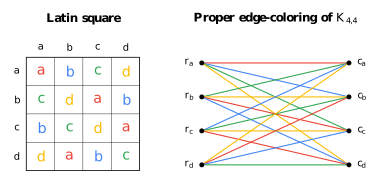
Latin squares can be viewed as edge-colorings of complete bipartite graphs. Let $R$, $C$, and $S$ be sets of size $n$. We think of $R$ as the set of rows, $C$ as the set of columns, and $S$ as the set of symbols. Consider the complete bipartite graph $K_{R,C}$. The vertices are the elements of $R \cup C$, and every row vertex $r \in R$ is connected to every column vertex $c \in C$.
A Latin square $L : R \times C \to S$ gives an edge-coloring of $K_{R,C}$ by coloring the edge $rc$ with the symbol $L(r,c)$. The Latin square condition says exactly that this edge-coloring is proper. Indeed, fixing a row $r \in R$, the edges incident to $r$ are
\[\{\{r,c\} : c \in C\}.\]The colors on these edges are precisely the symbols appearing in row $r$. Since every symbol appears exactly once in row $r$, these $n$ incident edges receive all $n$ colors exactly once. Similarly, fixing a column $c \in C$, the edges incident to $c$ are
\[\{\{r,c\} : r \in R\}.\]The colors on these edges are precisely the symbols appearing in column $c$. Since every symbol appears exactly once in column $c$, these $n$ incident edges receive all $n$ colors exactly once. Therefore no two adjacent edges receive the same color.
Conversely, suppose we have a proper edge-coloring of $K_{R,C}$ using the colors in $S$. For each row $r \in R$ and column $c \in C$, define
\[L(r,c)=\operatorname{color}(\{r,c\}).\]Because the coloring is proper and each vertex has degree $n$, the $n$ edges incident to each vertex receive all $n$ colors exactly once. Thus every symbol appears exactly once in each row and exactly once in each column. Therefore $L$ is a Latin square. So a Latin square with symbol set $S$ is equivalent to a proper edge-coloring of $K_{R,C}$ using the colors in $S$.
Latin Squares as Triangle Decompositions
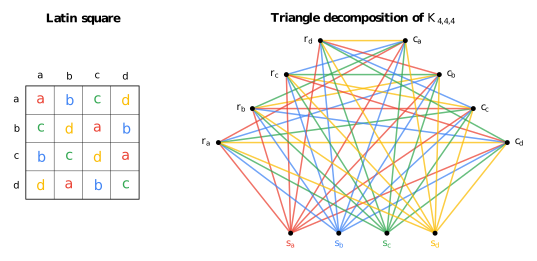
A Latin square can also be viewed as a triangle decomposition of a complete tripartite graph. Similar to above, let $R$, $C$, and $S$ be sets of size $n$, representing rows, columns, and symbols. Let $K_{R,C,S}$ be the complete tripartite graph with parts $R$, $C$, and $S$.
Every triangle in $K_{R,C,S}$ has the form ${r,c,s}$ where $r \in R$, $c \in C$, and $s \in S$. Given a Latin square $L : R \times C \to S$, we create one triangle for each cell:
\[\left\{\{r,c\},\{c,s\},\{r,s\}\right\}.\]where $s = L(r,c)$.
Claim: These triangles decompose the edges of $K_{R,C,S}$.
-
The edge $rc$ is covered by the triangle corresponding to the cell $(r,c)$.
-
The edge $rs$ is covered exactly once because symbol $s$ appears exactly once in row $r$.
-
The edge $cs$ is covered exactly once because symbol $s$ appears exactly once in column $c$.
Therefore every edge of $K_{R,C,S}$ appears in exactly one triangle. $\blacksquare$
Now suppose we have a triangle decomposition of $K_{n,n,n}$. Label the parts to represent the rows $R$, the columns $C$ and the symbols $S$. Since this is a triangle decomposition, there exists a unique vertex $s \in S$ for each possible $(r,c) \in R \times C$ that is contained in the triangle
\[\{\{rc\},\{rs\},\{cs\}\}\]We then define $L(r,c) = s$. Since every edge ${r,s}$ is covered exactly once, symbol $s$ appears exactly once in row $r$. Since every edge ${c,s}$ is covered exactly once, symbol $s$ appears exactly once in column $c$. Thus $L$ is a Latin square.
So Latin squares of order $n$ are equivalent to triangle decompositions of $K_{n,n,n}$.
Latin Squares as Permutation Tensors
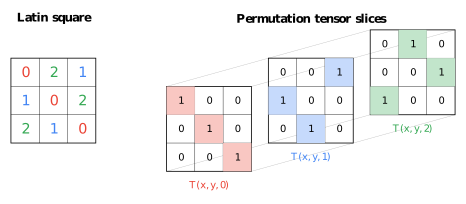
A Latin square can also be encoded as a $3$-dimensional $0$-$1$ tensor. Let $R$, $C$, and $S$ be sets of size $n$. Given a Latin square $L : R \times C \to S$, define $T_L: R\times C \times S \to {0,1}$ by
\[T_L(r,c,s) = \begin{cases} 1 & \text{if } L(r,c)=s, \ 0 & \text{otherwise.} \end{cases}\]The tensor $T_L$ records exactly the same information as the Latin square. The Latin square conditions imply that $T_L$ has exactly one $1$ in every coordinate line. This is the $3$-dimensional analogue of a permutation matrix, so we can think of $T_L$ as a permutation tensor.
Pictured below is the permutation tensor associated with a Latin square.From the diagram it is easy to see that each coordinate line only has a single $1$. The figure illustrates how the symbols in the latin square can also be thought of as a height map.
Latin Hypercubes
Latin squares have higher-dimensional analogues called Latin hypercubes. A $d$-dimensional Latin hypercube of order $n$ is a function
\[L : X_1 \times X_2 \times \cdots \times X_d \to S\]where each set $X_i$ and the symbol set $S$ have size $n$, and where every axis-parallel line contains each symbol exactly once. In other words, if all input coordinates except one are fixed, then the remaining map to $S$ is a bijection. When $d=2$, this is exactly a Latin square.
Groups give a simple source of examples. Let $G$ be a finite group of order $n$. We can define
\[L(x_1,\dots,x_d)=x_1x_2\cdots x_d.\]If all variables except $x_i$ are fixed, then the equation
\[x_1x_2\cdots x_d=s\]has a unique solution for $x_i$ because we can multiply by inverses. Thus this gives a Latin hypercube.
The equivalences for Latin squares generalize naturally.
First, a Latin hypercube can be viewed as an edge-coloring of the complete $d$-partite $d$-uniform hypergraph with parts $X_1,\dots,X_d$. Each transversal edge $\{x_1,\dots,x_d\}$ receives the color
\[L(x_1,\dots,x_d).\]The Latin hypercube condition says that whenever we fix $d-1$ vertices from different parts, the remaining edges through them receive all symbols exactly once. This means that the link hypergraph on a set of $d-2$ is a proper edge coloring of a complete bipartite graph.
Second, a Latin hypercube can be viewed as a clique decomposition of a complete partite hypergraph. Consider the complete $(d+1)$-partite $d$-uniform hypergraph with parts $X_1,\dots,X_d,S$. Each entry
\[L(x_1,\dots,x_d)=s\]gives a $(d+1)$-vertex set $\{ x_1,\dots, x_d, s \}$. This set spans a copy of $K_{d+1}^{(d)}$, meaning it contains all of its $d$-element subsets. The Latin hypercube condition says that these copies of $K_{d+1}^{(d)}$ decompose all transversal $d$-sets.
Finally, a Latin hypercube can be encoded as a higher-dimensional permutation tensor. Define
\[T_L: X_1 \times \cdots \times X_d \times S \to \{0,1\}\]by
\[T_L(x_1,\dots,x_d,s) = \begin{cases} 1 & \text{if } L(x_1,\dots,x_d)=s, \\ 0 & \text{otherwise.} \end{cases}\]The Latin hypercube condition says that $T_L$ has exactly one $1$ in every coordinate line.
Thus Latin hypercubes generalize Latin squares as arrays, edge-colorings, clique decompositions, and permutation tensors.
Sources and Further Reading
The exposition above is based on standard references on Latin squares, quasigroups, and design theory.
-
J. Dénes and A. D. Keedwell, Latin Squares and Their Applications, Academic Press, 1974.
-
J. Dénes and A. D. Keedwell, Latin Squares and Their Applications, Second Edition, Elsevier, 2015.
-
Charles J. Colbourn and Jeffrey H. Dinitz, editors, Handbook of Combinatorial Designs, Second Edition, Chapman and Hall/CRC, 2006.
-
Douglas R. Stinson, Combinatorial Designs: Constructions and Analysis, Springer, 2004.
-
Charles C. Lindner and Christopher A. Rodger, Design Theory, Second Edition, Chapman and Hall/CRC, 2008.